API GH & KH Test Kit
The kit planted-tank and shrimp keepers actually need — a liquid titration for general and carbonate hardness, the parameters strips only guess at.
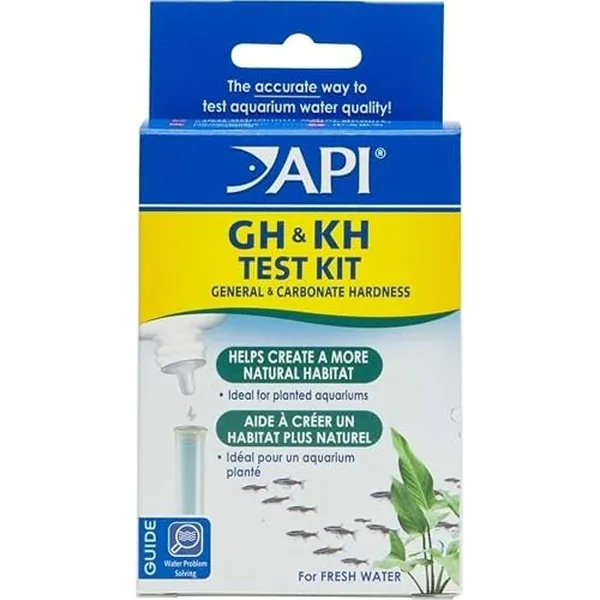
- +Titration drop-count gives a hard number for GH and KH instead of a guessed colour
- +Hundreds of tests per bottle, with reagent refills available for a low cost per test
- +Granular readings that matter for shrimp, buffering and planted-tank CO2
- +Numbered vials, a clear colour chart and good instructions
- −Two tests to run — GH then KH — each by drop-counting
- −Needs a steady hand and decent light to spot the colour change
This is the API GH & KH Test Kit, a liquid titration for general and carbonate hardness, giving a hard number by drop-count rather than a guessed colour. It is the kit planted-tank and shrimp keepers actually need, with roughly 1,600 combined tests and refills available.
- Shrimp keepers, who need GH and KH in range
- Planted tanks running CO2, where KH matters for buffering
- Anyone on unknown tap water who needs real hardness numbers
- Anyone who only needs the nitrogen cycle, where a master kit fits
- People who want a one-step reading, since it is a titration
- Testing in poor light, where the colour change is hard to spot
We separate what the maker claims from what independent sources confirm, what owners report, and where we are drawing an inference. We do not bench-test products.
- Liquid titration for GH and KH
- Roughly 1,600 tests combined; refills available
- Numbered vials and a colour reference
- Drop-count titration gives a hard number, not a guessed colour
- Two separate tests, GH then KH
- Very well rated by planted and shrimp keepers
- The kit strips only guess at: real GH and KH numbers that matter for shrimp, buffering and CO2, at a low cost per test with refills
Very low cost per test given roughly 1,600 tests and available refills. Each parameter is a separate drop-count, so it takes a little longer than a single dip, and needs decent light to read the colour change.
- Miscounting drops or missing the colour change in poor light
- Confusing the GH and KH tests
- Aged reagents that drift
We do not lab-verify accuracy; we relay the manufacturer's specifications and well-documented usage caveats. We give gear and method guidance only, not livestock or disease advice; route fish-health questions to a veterinarian or an established authority.
Shrimp need GH and KH in specific ranges, and KH buffers pH, which matters for planted CO2 tanks. Strips only estimate hardness; this gives a real number.
You add reagent drop by drop until the colour changes; the number of drops is your result. Do it in good light for a clear endpoint.
Yes, which keeps the cost per test very low over time.