API 5-in-1 Test Strips (100-count)
The fast everyday check — five parameters in about a minute. Less granular than liquid, but the most-reviewed strips in the hobby.
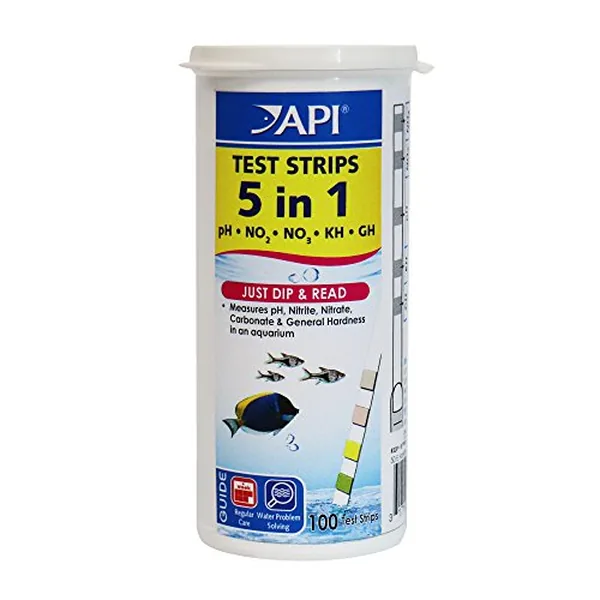
- +Reads pH and KH plus GH, nitrite and nitrate in about a minute
- +The most-reviewed strips here by a wide margin — a huge, broadly satisfied owner base
- +100-count box drops the cost per test for routine weekly checks
- +Distinct colours that are easy to distinguish against the bottle chart, with good instructions
- −Strips are vague at the low end next to a liquid kit
- −Narrow range on nitrate makes fine-tuning hard
- −No ammonia pad — you still need a separate ammonia test
These are API 5-in-1 Test Strips, 100 to a box, reading pH, KH, GH, nitrite and nitrate in about a minute. They are the fast everyday check: less granular than a liquid kit, but the most-reviewed strips in the hobby. There is no ammonia pad, so you still need a separate ammonia test.
- Fast weekly checks of an established tank
- Keepers who want a broad five-parameter snapshot quickly
- High-frequency routine testing where cost per test matters
- Cycling a new tank, where liquid accuracy and an ammonia test matter
- Fine-tuning at the low end, which strips read vaguely
- Diagnosing a crisis, where a liquid kit is more reliable
We separate what the maker claims from what independent sources confirm, what owners report, and where we are drawing an inference. We do not bench-test products.
- Reads pH, KH, GH, nitrite and nitrate in about a minute
- 100-count box; roughly a 2-year sealed shelf life
- No ammonia pad, so a separate ammonia test is still needed
- Strips are vague at the low end and narrow on nitrate
- The most-reviewed strips here, with a broadly satisfied owner base
- The convenience pick for routine checks; keep a liquid kit for cycling and for confirming anything alarming
Low cost per test in the 100-count box for routine weekly checks. Keep the tube sealed and dry, and pair with a liquid kit for the accuracy strips lack when it matters.
- Reading them as precise when they are approximate at the low end
- No ammonia reading, a gap during cycling
- Degraded strips if the tube is left open to humidity
We do not lab-verify accuracy; we relay the manufacturer's specifications and well-documented usage caveats. We give gear and method guidance only, not livestock or disease advice; route fish-health questions to a veterinarian or an established authority.
No, there is no ammonia pad. You still need a separate ammonia test, which is why strips alone are not enough for cycling a new tank.
For a quick routine snapshot, yes. For cycling or troubleshooting, a liquid kit reads far more granularly and is the better tool.
Around two years sealed. Keep the tube closed and dry, since humidity ruins strips.