API Freshwater Master Test Kit
The accuracy reference for freshwater: a liquid reagent kit that reads far more granular than strips and covers the full ammonia nitrite nitrate cycle plus high- and low-range pH.
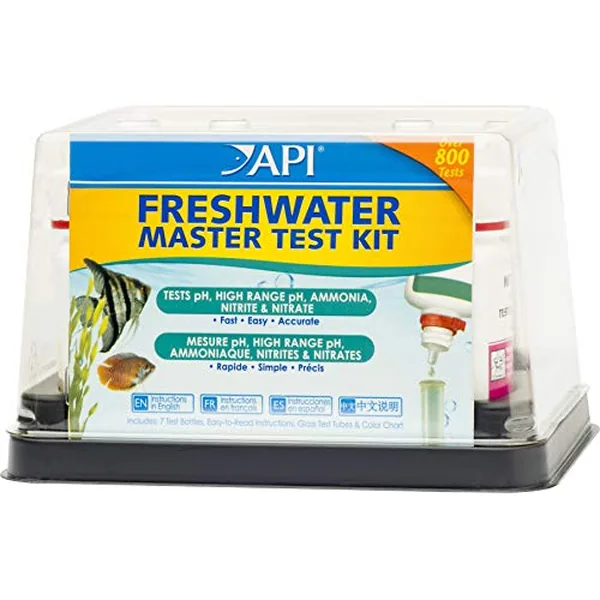
- +Liquid reagent drops give granular readings a colour-pad strip cannot match
- +Full range across the core parameters — the whole ammonia nitrite nitrate cycle plus high- and low-range pH
- +Hundreds of tests per kit, and individual reagent refills available keep the cost per test low
- +Four numbered vials and a laminated card with a clear colour chart and good instructions
- +Widely regarded as matching lab results when the reagents are fresh and shaken properly
- −The multi-vial, multi-drop routine takes a few minutes — slower than dipping a strip
- −Reagent bottles age, so a years-old kit drifts and should be replaced
This is the API Freshwater Master Test Kit, a liquid-reagent (colorimetric) kit that covers pH, high-range pH, ammonia, nitrite and nitrate, which is the full cycle. It comes with four glass vials, a laminated colour card and enough reagent for roughly 800 tests, and individual reagent refills are sold separately.
- Anyone cycling a new tank, where the ammonia, nitrite and nitrate progression is the whole point
- Keepers who want granular readings that colour-pad strips cannot match
- Troubleshooting fish loss or algae, where accuracy matters
- Long-term monitoring, since refills keep the cost per test low
- Anyone who wants a ten-second answer, since the multi-vial routine takes a few minutes
- Keepers who will not shake the reagents properly, because readings then drift
- Reef-specific parameters, which need dedicated saltwater kits
- A years-old kit, since reagents age and should be replaced
We separate what the maker claims from what independent sources confirm, what owners report, and where we are drawing an inference. We do not bench-test products.
- Tests pH, high-range pH, ammonia, nitrite and nitrate
- Around 800 tests per kit
- Roughly a 3-year unopened shelf life
- Individual reagent refills available
- Liquid colorimetric reagents read more granularly than strip pads
- It ships with four numbered vials and a colour card
- The nitrate reagent must be shaken hard or it under-reads
- Widely regarded as matching lab results when reagents are fresh and shaken properly
- The routine is slower than strips, and old kits drift
- This is the accuracy reference for home freshwater, and the single most useful tool for a new keeper during cycling
- With refills, the cost per test is very low over years
The kit is a one-time cost, and individual reagent refills keep the cost per test very low over time. The limiting factor is reagent age rather than test count, so replace the reagents every few years by date even if bottles are not empty.
- Under-shaking the nitrate number 2 bottle gives a falsely low nitrate reading, which is the classic error
- Reading the colour pads under poor light
- Expired or years-old reagents that drift
- Cross-contaminating vials that are not rinsed between tests
- Confusing the regular and high-range pH tests
We do not lab-verify accuracy; we relay API's specifications and the well-documented shake-and-freshness caveats. Interpreting results against a fish's health is a veterinary question, not one we answer.
For accuracy, yes. Liquid drops read far more granularly than strip pads, which matters when you are cycling a tank or troubleshooting a problem.
The nitrate reagent number 2 must be shaken hard for about a minute and banged to remix the crystals. Under-shaking is the number-one cause of a falsely low nitrate reading.
Around 800 tests, but the reagents age over roughly three years. Replace them by date, not just when a bottle runs out.
It reads the same core parameters, but reef-specific values such as calcium and alkalinity need dedicated kits.