API Master Test Kit vs Test Strips: Which Is Better?
API Freshwater Master Test Kit vs test strips: liquid is more accurate and cheaper per test; strips are faster. Which to use, and when.
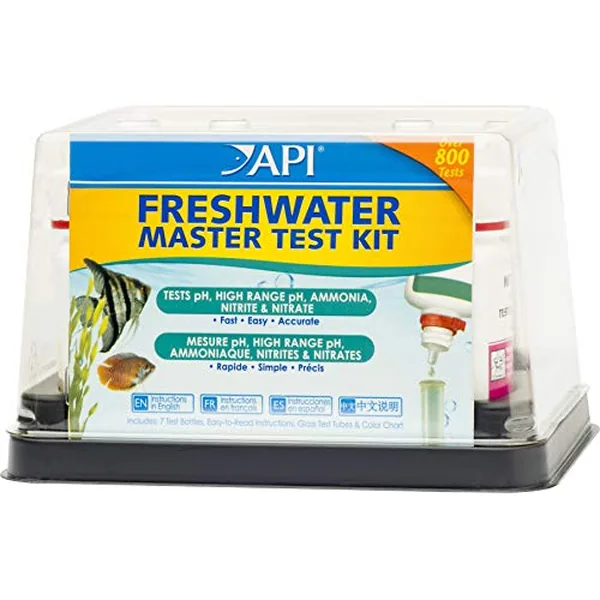
The liquid API Freshwater Master Test Kit is more accurate and cheaper per test — use it for cycling a new tank and diagnosing problems. Test strips (API 5-in-1, Tetra EasyStrips) are faster and fine for a quick weekly glance, but they read vague at the low end and cost far more per test. Buy the liquid kit; keep strips around for convenience.
| Product | Score | Accuracy & Range | Cost Per Test | Ease of Reading | Owner Satisfaction | Value | Buy |
|---|---|---|---|---|---|---|---|
| API Freshwater Master Test Kit API · premium | 89 | 100 | 100 | 100 | 86 | 65 | Buy → |
| API 5-in-1 Test Strips (100-count) API · mid-range | 85 | 79 | 89 | 98 | 82 | 77 | Buy → |
| Tetra EasyStrips 6-in-1 Test Strips (25-count) Tetra · budget | 87 | 74 | 95 | 98 | 82 | 87 | Buy → |
The short version
This is a decided question with a defensible answer: for anything that matters, liquid wins. A liquid reagent kit reads a real number; a strip gives you a colour that lands somewhere in a range. Reviewers who test both put it bluntly — liquid kits give a number you can act on, strips give a ballpark. Strips are not useless, though: they are faster and genuinely handy for a quick weekly "is anything obviously off?" check.
Where the liquid kit pulls ahead
- Accuracy. Drops and a colour card resolve the low end — exactly where it counts, because ammonia and nitrite are dangerous at low readings while a tank cycles.
- Coverage. The Master kit does the whole ammonia-nitrite-nitrate cycle plus pH in one box.
- Cost per test. This surprises people: the ~$36 kit runs to hundreds of tests, so per reading it is cheaper than strips, not dearer.
Where strips still make sense
Strips are faster and need no tubes or drops. For an established, stable tank, a quick weekly strip dip to spot a big swing is perfectly reasonable — and the API 5-in-1 and Tetra EasyStrips are the ones to reach for. Just do not trust a strip to tell you a cycling tank is safe; that is the one time you want the liquid kit's precision.
The verdict, by situation
| You are… | Use |
|---|---|
| Cycling a new tank | Liquid Master kit (ammonia + nitrite daily) |
| Diagnosing a sick or cloudy tank | Liquid Master kit |
| Doing a fast weekly check on a stable tank | Strips |
| On a tight budget but want accuracy | Liquid Master kit (cheapest per test) |
Bottom line
Buy the API Freshwater Master Test Kit — it is more accurate, covers the cycle, and costs less per reading. Keep a tube of API 5-in-1 or Tetra EasyStrips for a quick glance, but reach for the liquid whenever the answer actually matters.
For accuracy and cost-per-test the liquid API Freshwater Master Test Kit wins — use it for cycling and diagnosing. Strips (API 5-in-1, Tetra EasyStrips) are fine for a fast weekly glance, not for telling you a cycling tank is safe.
Common questions
Are aquarium test strips accurate?
They are fine for a quick weekly glance but less precise than liquid tests, and readings vary with dip time and angle. For cycling a new tank or diagnosing a problem, use the liquid kit; keep strips for fast routine checks.
How often should I test my aquarium water?
While cycling a new tank, test every day or two to track ammonia, nitrite and nitrate. On an established tank a weekly or biweekly check is plenty, plus a test any time the fish look unwell or after a large change.
Is the API Master Kit cheaper than test strips?
Per test, usually yes. The liquid kit costs more upfront but includes hundreds of tests, so the cost per reading is lower over time. Strips are cheaper to buy but cost more per test and lose accuracy once the tub is opened.