New Life Spectrum Regular (150 g)
The premium daily staple: a high protein, whole fish protein pellet with no fillers and colour enhancing algae, readily accepted by almost any community fish. Small slow sinking pellets most keepers rate the best all-round food.
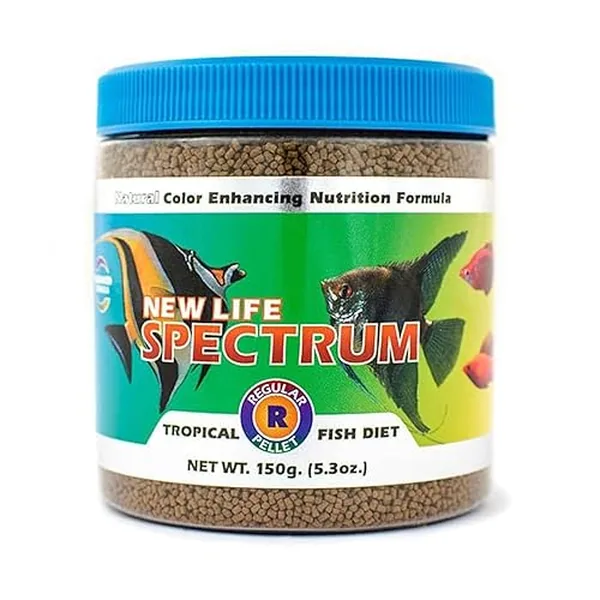
- +Whole fish protein first, plus krill and colour enhancing algae — high protein with no fillers
- +Readily accepted by almost any community fish — a proven all-round staple
- +Small, slow sinking pellets reach every level of the tank and are easy to portion
- +Vitamin stabilised, and holds together with low waste and no clouding of the water
- −Small pellets can be a touch big for the tiniest nano fish until they soften
- −One of the pricier staples per gram
This is New Life Spectrum Regular, a 150 g pot of roughly 1 mm slow-sinking pellets built on whole fish protein plus krill and colour-enhancing algae, with no fillers and vitamin stabilisation. It is a daily staple for community tropical fish.
- Community tropical fish of most sizes
- Keepers who want a high-protein, filler-free daily staple
- Mixed tanks, since a slow-sinking pellet reaches mid-water and bottom feeders
- Anyone who wants colour enhancement from krill and algae
- The tiniest nano fish until the pellet softens, so soak or crush it first
- Dedicated herbivores that need an algae or spirulina-first food
- Strict-budget feeders, since it is one of the pricier staples per gram
- Bottom-feeder-only tanks that need wafers or tablets
We separate what the maker claims from what independent sources confirm, what owners report, and where we are drawing an inference. We do not bench-test products.
- Whole fish protein first, plus krill and colour-enhancing algae
- No fillers and vitamin stabilised
- Roughly a 1 mm slow-sinking pellet
- Low ash and low moisture
- It is a nutrient-dense pellet accepted by most community fish
- Slow-sinking pellets reach several levels of the tank
- It holds together with little clouding of the water
- Widely rated among the best all-round staples
- The pellet can be slightly large for the smallest nano fish until it softens, and it is one of the pricier foods
- Whole-fish-protein-first with no filler is the meaningful spec here
- It is the daily staple we would default to for a mixed community tank, fed in small pinches
A 150 g pot lasts a typical community tank a long time because you feed only a small pinch once or twice a day, so the cost per feeding is low despite the higher price per gram. Reseal it to keep it dry, and buy a size you will finish within its freshness window.
- Overfeeding, the commonest error, which fouls the water; feed only what is eaten in a couple of minutes
- Pellets too large for tiny fish, which soaking or crushing solves
- Leaving the pot open, so moisture spoils the food
- Using it as the sole food for specialist herbivores or bottom feeders that need a different diet
We do not lab-test nutrition; we relay the manufacturer's ingredient claims and paraphrased owner consensus. For a fish with a specific dietary or health need, consult a veterinarian or an established authority.
Yes. It is a proven all-round staple accepted by most community tropicals, and the slow-sinking pellets reach every level of the tank.
Soak a few pellets for a minute to soften them, or crush them. The roughly 1 mm size can be big for the smallest fish until it swells.
A small pinch once or twice a day, only what is eaten in a couple of minutes. Overfeeding is the main way any food harms a tank.
It holds together with low waste. Clouding usually means overfeeding rather than the food itself.