Best Food for Betta Fish: Pellets, Protein and Portions
The best food for betta fish: why an insect-based pellet suits their carnivore diet, which one to buy, and how little to actually feed.
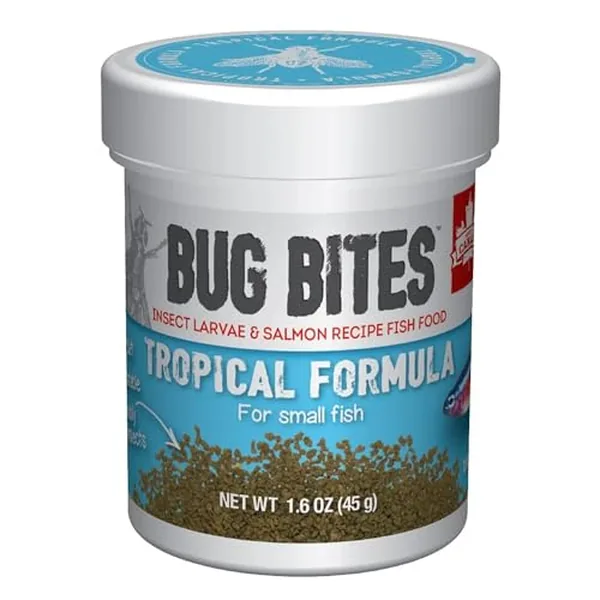
Bettas are carnivores that eat insects and small invertebrates in the wild, so the best everyday food is a small, animal-protein pellet. An insect-based pellet like Fluval Bug Bites matches that diet closely and holds its shape without clouding the water. Whatever you pick, the portion is tiny: two or three pellets once or twice a day, with one fasting day a week. Overfeeding, not the brand, is what harms most bettas.
| Product | Score | Nutritional Quality | Feeding Behaviour | Water Clarity Impact | Owner Satisfaction | Value | Buy |
|---|---|---|---|---|---|---|---|
| New Life Spectrum Regular (150 g) New Life Spectrum · premium | 88 | 100 | 100 | 100 | 79 | 64 | Buy → |
| Fluval Bug Bites Tropical Granules (1.6 oz) Fluval · budget | 91 | 95 | 100 | 95 | 82 | 87 | Buy → |
| Hikari Tropical Micro Pellets (0.77 oz) Hikari · budget | 94 | 100 | 100 | 97 | 87 | 88 | Buy → |
What bettas actually eat
In the wild a betta is an ambush carnivore, picking off insects, larvae and small invertebrates at the surface. That is the diet to imitate: high in animal protein, low in plant filler. A food whose first ingredients are fish meal, krill or insect larvae fits; one built around wheat and soy does not.
The three foods compared above are all strong. The differences are protein source, pellet size and how they behave in the water.
Why an insect-based pellet wins
Fluval Bug Bites is our top pick for bettas specifically because its main ingredient is black soldier fly larvae, backed by salmon, with no fillers. That is about as close to a wild betta diet as a dry food gets. The granules are roughly 1 mm and sink slowly, so a betta can pick them off mid-water.
- Fluval Bug Bites: insect-first protein, ~1 mm, slow sinking
- Hikari Micro Pellets: ~0.4 mm, semi-floating, good for small mouths
- New Life Spectrum: nutrient-dense 1 mm sinking pellet, excellent all-rounder
If your betta is young or unusually small, the Hikari micro pellet is easier to swallow. If you keep other community fish too, New Life Spectrum feeds the whole tank well.
Portion is the thing that matters
Here is the part that saves fish. A betta's stomach is roughly the size of its eye. Two or three pellets, once or twice a day, is a full meal.
| Habit | Result |
|---|---|
| 2-3 pellets, 1-2x day | Healthy weight |
| A pinch "until they stop" | Bloat, fouled water |
| One fasting day a week | Better digestion |
Overfeeding is the leading cause of betta health problems. It bloats the fish and rots on the substrate, spiking ammonia in what is usually a small tank. When in doubt, feed less.
Storage and variety
Buy the smallest tub that is sensible. Dry food loses nutritional value over months once opened, and a single betta eats astonishingly little, so a large tub will go stale long before it is finished. Keep it sealed, cool and dry.
For variety, the odd treat of frozen or freeze-dried bloodworms or daphnia is welcome, but keep it occasional; a pellet with a complete formulation should stay the everyday staple. If your betta is refusing food, our picky-eater guide covers what to try next.
Feed a betta a small animal-protein pellet. Fluval Bug Bites is our pick because its first ingredient is insect larvae, which is close to a betta's natural diet. Hikari Micro Pellets suit smaller mouths, and New Life Spectrum is a strong nutrient-dense all-rounder. Feed two or three pellets at a time, no more.
Common questions
How many pellets should I feed a betta?
Two or three small pellets, once or twice a day. A betta's stomach is about the size of its eye, so that really is enough. Many keepers add one fasting day a week to help digestion. Uneaten food rotting on the substrate is a bigger water-quality problem than slight underfeeding.
Are pellets or flakes better for bettas?
Pellets, generally. They hold their shape, are easy to portion, and foul the water less than flakes, which break up and drift. Choose a small pellet a betta can swallow whole; a large pellet can cause choking or bloating.
Can bettas eat tropical flakes or community food?
Occasionally, but not as a staple. Many community foods are lower in animal protein than a betta needs, and flakes foul the water faster. A dedicated small carnivore pellet, with the odd treat of frozen or freeze-dried bloodworms, is a better everyday diet.