Seachem Prime vs API Tap Water Conditioner: Which to Buy
Seachem Prime vs API Tap Water Conditioner: both dechlorinate, but only Prime detoxifies ammonia — which matters more than price on chloramine tap.
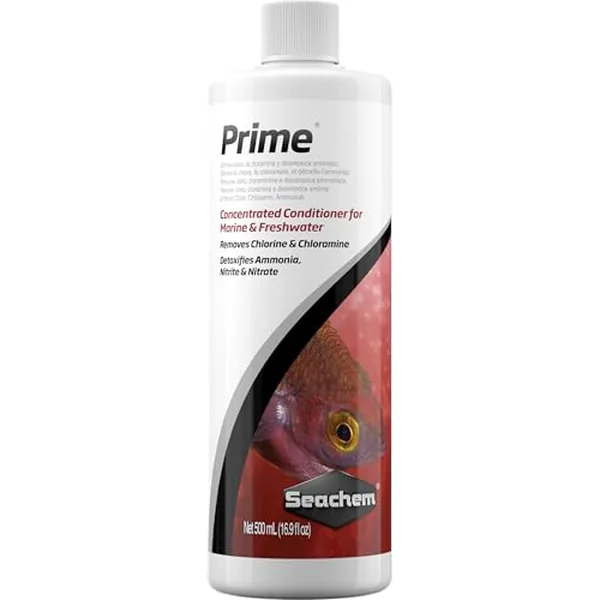
Both remove chlorine and neutralise chloramine, and both are cheap per gallon. The difference: Seachem Prime also detoxifies ammonia and nitrite, which matters on chloramine tap water and while cycling. Buy Prime for the safety margin; buy API Tap Water Conditioner to save money if your water is chlorine-only and your tank is established.
| Product | Score | Effectiveness & Range | Concentration & Value | Safety Margin | Owner Satisfaction | Value | Buy |
|---|---|---|---|---|---|---|---|
| Seachem Prime (500 mL) Seachem · mid-range | 94 | 100 | 100 | 100 | 94 | 79 | Buy → |
| API Tap Water Conditioner (16 oz) API · budget | 94 | 98 | 100 | 97 | 88 | 88 | Buy → |
Both do the basics; one does more
Every dechlorinator worth buying removes chlorine and neutralises chloramine, works instantly, and is cheap enough to dose forever. On those jobs, Seachem Prime and API Tap Water Conditioner are a tie. The table above really comes down to a single row: does it detoxify ammonia?
Why ammonia is the whole argument
Most US water utilities switched from chlorine to chloramine years ago because it is more stable in the pipes. That stability is the problem for a fish tank: chloramine does not gas off on its own, and when a conditioner breaks the chloramine bond it releases ammonia into the water. Seachem Prime binds and detoxifies that ammonia (and nitrite); API Tap Water Conditioner removes the chlorine and heavy metals but leaves the ammonia behind. On chloramine tap, that gap is the difference between safe water and a small ammonia dose with every water change.
When Prime is worth the extra dollar or two
- Your utility uses chloramine — check your annual water report; most do now.
- You are cycling a new tank, when ammonia and nitrite spike for weeks.
- You want an emergency backstop: in an ammonia spike you can dose Prime for the whole tank volume to bind it for a day or two while you catch up on water changes. It is temporary — binding, not removing — so it buys time rather than fixing the cause.
When API Tap Water Conditioner is the smarter buy
- Your tap is chlorine only (some wells and older municipal systems).
- An established, cycled tank whose mature filter already handles ammonia.
- You want the lowest cost per gallon for plain dechlorination: at 1 mL per 20 gallons it is the most concentrated dechlorinator of the two, and a 16 oz bottle lasts months of weekly water changes.
What keepers actually say
Community consensus leans hard toward Prime as the default, mostly for the ammonia detox and the emergency use, while granting that API Tap Water Conditioner is a perfectly good, cheaper choice when you know your water is chlorine-only. The recurring caution in the r/Aquariums water-chemistry threads: Prime's detox lasts only about 24-48 hours, so treat it as a stopgap, not a fix.
Bottom line
For most people — anyone on chloramine, anyone cycling — Seachem Prime earns its small premium through the ammonia detox and the emergency safety net. If your water is chlorine-only and your tank is established, API Tap Water Conditioner does the dechlorinating job for less. Buy Prime for the safety margin; buy API Tap to save money when you genuinely do not need it.
For anyone on chloramine or cycling a tank, Seachem Prime is worth the small premium for its ammonia detox and emergency use; API Tap Water Conditioner is the cheaper pick when your water is chlorine-only and the tank is established.
Common questions
Is Seachem Prime better than API Tap Water Conditioner?
Prime is more concentrated and also detoxifies ammonia and nitrite, so it treats far more water per bottle and doubles as an emergency aid during a cycle. API is cheaper up front and fine as a basic dechlorinator if you do not need the ammonia protection.
How much Seachem Prime do I use?
The label rate is about 5 mL (one capful) per 50 gallons of new water. When treating only a water change, dose for the volume of new water going in, not the whole tank.
Can you overdose water conditioner?
Most conditioners tolerate a wide margin over the label dose, so rounding up slightly will not harm fish, plants or the biofilter. Follow the dose on your own bottle, since formulas differ.