Best Light for a 20-Gallon Tank: Fit, PAR and Plants
The best light for a 20-gallon tank: a 24-inch full-spectrum LED matched to your plants, with picks for fish-only, easy plants and a planted tank.
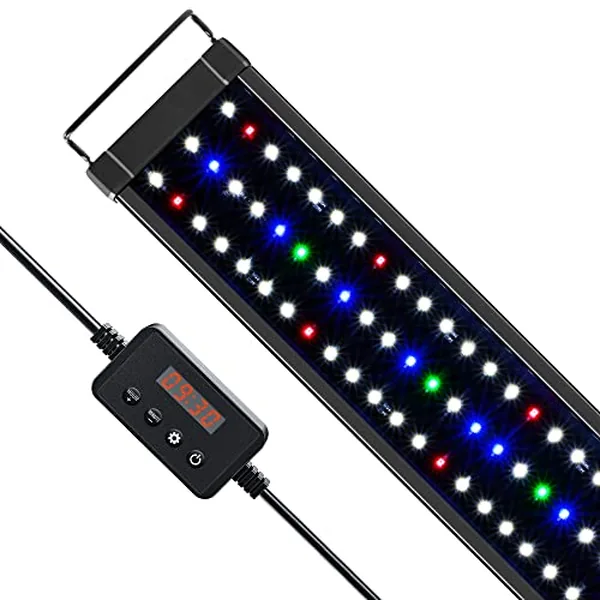
A standard 20-gallon is 24 inches long, so you want a 24-inch fixture. For fish-only tanks or easy low-light plants, the NICREW ClassicLED Plus fits and does the job cheaply. For a properly planted 20-gallon you want more usable light at depth, which is where a fixture like the Finnex Stingray 3 earns its price. Match the light to your plant ambition, not the other way around, and put it on a 6 to 8 hour timer to keep algae down.
| Product | Score | Light Output & Spectrum | Plant Growth Capability | Build & Controls | Owner Satisfaction | Value | Buy |
|---|---|---|---|---|---|---|---|
| NICREW ClassicLED Plus (18W, 24-30 in) NICREW · budget | 90 | 100 | 89 | 96 | 82 | 87 | Buy → |
| Finnex Stingray 3 (24 in) Finnex · mid-range | 86 | 99 | 87 | 99 | 72 | 77 | Buy → |
| hygger 18W 24/7 LED hygger · budget | 90 | 95 | 95 | 96 | 80 | 87 | Buy → |
Start with fit, then plants
Two things decide a 20-gallon light: whether it physically fits, and how much light your plants need. Get those right and the rest is detail.
A standard 20-gallon "high" is 24 inches long. A 20-gallon "long" is 30 inches. That difference matters, because a fixture sized for the wrong one will either overhang or leave dark ends. Most LED bars here use extendable brackets, but always measure first.
The picks, by plant ambition
| Tank | Pick | Light level |
|---|---|---|
| Fish only / easy plants | NICREW ClassicLED Plus | Low to medium |
| Budget with 24/7 modes | Hygger 18W 24/7 | Low to medium |
| Proper planted tank | Finnex Stingray 3 | Medium, even spread |
The NICREW ClassicLED Plus is the default. It fits a 24-inch tank, runs a full white-plus-RGB spectrum, and covers fish-only tanks and undemanding plants like anubias and java fern for around forty dollars.
When to spend more
If you want a lush, densely planted 20-gallon, buy for PAR at depth, not just brightness at the surface. A 20-gallon high is about 16 inches deep, and cheaper fixtures lose punch by the time light reaches the substrate.
The Finnex Stingray 3 is the planted-tank choice here: a low-profile fixture with an even spread that supports medium-light plants without tipping straight into an algae farm. The Hygger 18W sits in between on price and adds built-in day-and-night lighting modes if you like that convenience.
Keep the timer honest
Whatever you buy, the most important setting is free: a timer. Six to eight hours a day is right for almost every tank.
- Too long: algae on the glass and plants
- Too short: plants sulk and drop leaves
- Just right: steady growth, clear glass
If algae appears, shorten the photoperiod before you change anything else. Our guide on how long to run an aquarium light goes deeper, and the planted-tank light guide covers higher-tech setups.
For a 24-inch 20-gallon, the NICREW ClassicLED Plus is the best default: it fits, it is full spectrum, and it covers fish-only tanks and easy plants for around forty dollars. Choose the Finnex Stingray 3 if you are serious about plants, and the Hygger 18W if you want built-in day-and-night modes on a budget.
Common questions
What size light does a 20-gallon tank need?
A standard 20-gallon high is 24 inches long, so a 24-inch fixture is the match; most have extendable brackets that cover 24 to 30 inches. A 20-gallon long is 30 inches, so measure your tank before buying rather than going by the gallon number alone.
How long should I run the light?
Six to eight hours a day on a timer. Plants do not benefit much from longer, and extra hours mainly feed algae. If you are getting algae, shortening the photoperiod is the first lever to pull, ahead of buying anything.
Do I need a strong planted-tank light for a 20-gallon?
Only if you want demanding plants. Low-light plants like anubias, java fern and cryptocoryne thrive under an inexpensive fixture. High-light carpeting plants need more PAR at depth and usually added CO2, which is a bigger commitment than the light alone.